
SCADA
The basics of Supervision Control And Data Acquisition
Analog Inputs
A lot of what is said about the Digital Inputs is valid for the Analog Inputs, but these represent a variable or an entity that can be represented by a number.
Consider a temperature, a voltage, a volume of a liquid. Any of these entities can be represented by a number and measured by the SCADA local units, translating that measurement into a number. This number will be changing in time and must be read at defined intervals to be registered and processed.
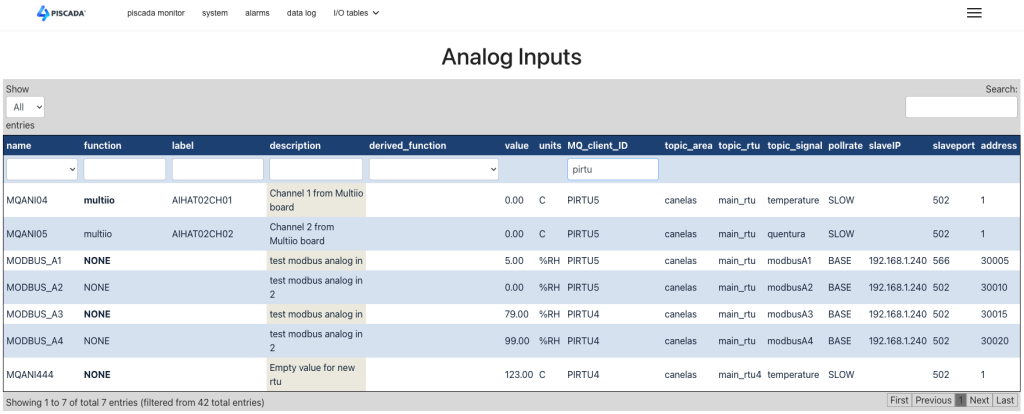
This means that analog values go through a process of sampling – register a value at regular intervals, and then decide what to do with these values. Some variable will change fast and bring too many changes that are not important for the final result. To control and define this sensitivity to change we must define a couple of functions and parameters such as:
- – Sample rate – define the time interval between two consecutive samples.
- Min and Max values – in most situations the entity we measure via some sort of transducer or electronic means has a lower and a upper limit of measure.
- Unit of measure
- Scale – a factor that translates the value we receive to a unit of measure, usually assuming a linear conversion.
- Alarm definition
○ Do we want an alarm when the value goes above a limit value?
○ Do we want an alarm when the value goes below a limit value?
○ What text to use on each of these situations
○ Do we register or LOG values at regular db defined intervals in our historic file.
○ Specific text message for the Log register. - How to consider that a change in the value is a change we should report? This is similar to the anti bounce described for digital inputs, but applied to a measure. In this case the solution is called hysteresis. This is a percentage of the full range of values. For example a min value of 0 with a maximum value of 1,000 has a range of 1,000. defining hysteresis as 0.1% means that 0.1%*1,000=1 so if our reading is currently 50.4 we will only process a change going up when we reach 51.4. (insert drawing)
- Use of “DERIVED” values is also possible, similar to digital inputs. In this case very useful to convert measurements of different units. Say you are monitoring a tank level by determining its volume in Liters. And our measure is based on the distance of the sensor to the liquid surface. Then we need to know constant values like the depth of the tank, its total volume, any correction from the sensor distance for the full tank situation. In Power applications a simple or vector calculation to determine power based on two separate measurements of current and voltage. These derived values have all the same parameters of a direct measurement and can be used in the calculation of another derived value. Just like the sampling of direct measurements, these derived values are calculated at specific time intervals.
Analog Outputs
With the increased used of digital control systems it is less common to use an analog set point to define a control loop. Most of these actions are controlled by setting a value in a register of another system, so although not actually corresponding to an analog variable like a 4-20mA current, we can still define setpoints or Analog Outputs, that are numerical values that will be transmitted to some local control system in a form of an integer or a real value.
In these situations we may want to set alarm limits for low and high values, just as before with the analog inputs.
Logging is also common in these situations, so the same parameters will apply as for the Inputs.